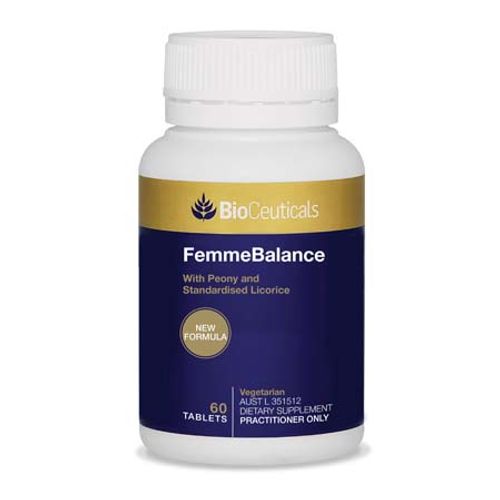
FEMMEBALANCE 60Tabs
RRP $46.95 Inc GST
FEMMEBALANCE 60Tabs
FemmeBalance features peony which is used in traditional Chinese medicine (TCM) to relieve menstrual cycle irregularity. Vitamin B6 maintains healthy female hormonal balance, relieves symptoms of premenstrual tension including mood swings, and temporarily relieves mild fluid retention. Licorice is used in traditional Chinese medicine as an antispasmodic and to relieve abdominal pain and discomfort.
- Glycyrrhiza glabra (licorice) root 142.9 mg (min. equiv. to dry 2.5 g, std. to glycyrrhizinic acid 28.6 mg)
- Paeonia lactiflora (peony) root 150 mg (equiv. to dry 3 g)
- Cinnamomum cassia (cinnamon) stem bark 66.7 mg (equiv. to dry 1 g, equiv. to cassia oil 666.7 micrograms, equiv. to coumarin 3.33 micrograms)
- Taraxacum officinale (dandelion) leaf 150 mg (equiv. to dry 750 mg)
- Pyridoxal-5-phosphate monohydrate (P5P) (active vitamin B6) 39.2 mg, equiv. to pyridoxine 25 mg)
- Pyridoxine hydrochloride 30.4 mg (equiv. to pyridoxine (vitamin B6) 25 mg)
- Inositol (myo-inositol) 200 mg
Adults: At the first sign of pre-menstrual symptoms and during menstruation: Take 1 tablet two times a day. For short-term use during menstruation only.
KEEP OUT OF REACH OF CHILDREN.
Always read the label. Follow the directions for use.
If symptoms persist, talk to your health professional.
Supplements may only be of assistance if dietary intake is inadequate.
Do not use during pregnancy or breastfeeding.
Talk to your health professional before taking multiple products containing vitamin B6.
WARNING - Stop taking this medication if you experience tingling, burning or numbness and see your healthcare practitioner as soon as possible [Contains vitamin B6].
If fluid retention persists, seek medical advice.
Avoid using in pregnancy and lactation.
Glycyrrhiza glabra is contraindicated in pregnancy.
Paeonia lactiflora can cause uterine contractions.
Insufficient reliable information available for use in lactation.
Glycyrrhiza glabra is contraindicated in hypotonia, severe renal insufficiency, hypokalaemia, liver cirrhosis and cholestatic liver disease.
People with depression should talk to their doctor before taking Glycyrrhiza glabra; it may interact with their medicines.
Avoid long-term use (>2 weeks) of Glycyrrhiza glabra and diuretics concurrently unless under supervision; monitor potassium levels.
Glycyrrhiza glabra has been documented as having an anticoagulant effect, therefore high quantities should be avoided in patients taking blood-thinning medication.
Glycyrrhiza glabra should be used with caution in people with hypertension or fluid retention.
High-dose Glycyrrhiza glabra taken long-term can lead to increased blood pressure; monitor when high-dose (>100-400 mg glycyrrhizinic acid) is taken for longer than 2 weeks.
Avoid long term-use of high-dose (>100-400 mg glycyrrhizinic acid)Glycyrrhiza glabra and digoxin concurrently.
Concurrent use of Glycyrrhiza glabra may potentiate the effects of topical and oral corticosteroids.
Glycyrrhiza glabra may reduce testosterone levels; caution is advised in males with a history of impotence, infertility or decreased libido.
Caution is advised with concurrent use of the oral contraceptive pill and Glycyrrhiza glabra long-term and at high dose.
Observe patient for hypokalaemia, fluid retention and elevated blood pressure when taking >100-400 mg glycyrrhizinic acid for more than 2 weeks.
Paeonia lactiflora may have antiplatelet, anticoagulant and antithrombotic effects. Theoretically, when combined with anticoagulant or antiplatelet drugs it might increase the risk of bleeding.
Theoretically, Cinnamomum cassia may have additive effects with antidiabetic drugs. Caution advised.
Theoretically, due to diuretic effects, Taraxacum officinale might reduce excretion and increase levels of lithium.
Theoretically, Taraxacum officinale might increase the risk of hyperkalaemia when taken with potassium-sparing diuretics.
Vitamin B6 should not be used in high doses (>100 mg) long-term, as this can induce toxicity.
Concurrent use of anti-seizure medications with vitamin B6 should be monitored.
Theoretically, taking inositol with antidiabetic drugs may increase the risk of hypoglycaemia.
Caution -
Cinnamon: Hypoglycaemic agents
Cinnamon Improves Glucose and Lipids of People With Type 2 Diabetes
Cinnamon: not suitable for the treatment of diabetes mellitus
Cinnamon on Glucose Control and Lipid Parameters
Licorice: Antihypertensive agents
Liquorice-induced rise in blood pressure: a linear dose-response relationship.
Subjects with essential hypertension are more sensitive to the inhibition of 11 beta-HSD by liquorice.
Licorice: Laxatives
The influence of the sennosides on absorption of glycyrrhetic acid in rats.
Pseudohyperaldosteronism from liquorice-containing laxatives.
Licorice: Cyclosporin - Immunomodifiers
Liquorice reduced cyclosporine bioavailability by activating P-glycoprotein and CYP 3A.
Licorice Digoxin Cardiac inotropic agents
Congestive heart failure caused by digitalis toxicity in an elderly man taking a licorice-containing chinese herbal laxative.
Licorice: Midazolam - CYP3A4 substrates
Effect of glycyrrhizin on the activity of CYP3A enzyme in humans.
Licorice: Prednisolone - Adrenal steroid hormones
Effect of oral administration of glycyrrhizin on the pharmacokinetics of prednisolone
Clinical characteristics of five elderly patients with severe hypokalemia induced by glycyrrhizin derivatives.
Glycyrrhizin induces mineralocorticoid activity through alterations in cortisol metabolism in the human kidney
The inhibitory effects of glycyrrhizin and glycyrrhetinic acid on the metabolism of cortisol and prednisolone--in vivo and in vitro studies.
Effect of oral administration of glycyrrhizin on the pharmacokinetics of prednisolone.
Paeonia: Hypoglycaemic agents
Pharmacological investigations of the anti-diabetic effect of Cortex Moutan and its active component paeonol.
Vitamin B6: Levodopa - Movement disorders
Pyridoxine reversal of L-dopa effects in Parkinsonism.
Failure of vitamin B6 to reverse the L-dopa effect in patients on a dopa decarboxylase inhibitor.
Vitamin B6: Phenobarbitone - Anticonvulsants
Pyridoxine and serum concentration of phenytoin and phenobarbitone.
Vitamin B6: Phenytoin - Anticonvulsants
Pyridoxine and serum concentration of phenytoin and phenobarbitone.
Inconclusive -
Dandelion - Substrates of multiple CYP enzyme subtypes
Effect of herbal teas on hepatic drug metabolizing enzymes in rats
Licorice: Hyperacidity, reflux and ulcers
The influence of commonly prescribed synthetic drugs for peptic ulcer on the pharmacokinetic fate of glycyrrhizin from Shaoyao-Gancao-tang.
Repetitive administration of Shaoyao-Gancao-tang to rats restores the bioavailability of glycyrrhizin reduced by antibiotic treatment.
Licorice: Atazanavir
Herb-drug interaction between an anti-HIV Chinese herbal SH formula and atazanavir in vitro and in vivo.
Herb-drug interaction between an anti-HIV Chinese herbal SH formula and atazanavir in vitro and in vivo.
Licorice: Caffeine
The in-vivo effects of sho-saiko-to, a traditional Chinese herbal medicine, on two cytochrome P450 enzymes (1A2 and 3A) and xanthine oxidase in man.
Licorice: Esomeprazole (Nexium) - Hyperacidity, reflux and ulcers
To evaluate of the effect of adding licorice to the standard treatment regimen of Helicobacter pylori.
To evaluate of the effect of adding licorice to the standard treatment regimen of Helicobacter pylori.
Licorice: Esomeprazole (Nexium) - Hyperacidity, reflux and ulcers
Effect of glycyrrhizin on CYP2C19 and CYP3A4 activity in healthy volunteers with different CYP2C19 genotypes.
Licorice: Omeprazole (Prilosec, Zegerid, Omesec) - Hyperacidity, reflux and ulcers
Effect of glycyrrhizin on CYP2C19 and CYP3A4 activity in healthy volunteers with different CYP2C19 genotypes.
Licorice: Omeprazole (Prilosec, Zegerid, Omesec) - Hyperacidity, reflux and ulcers
Speculative -
Licorice: Warfarin - Anticoagulants, antithrombotics
Potential interactions between alternative therapies and warfarin.
Traditional Chinese medicines Wu Wei Zi (Schisandra chinensis Baill) and Gan Cao (Glycyrrhiza uralensis Fisch) activate pregnane X receptor and increase warfarin clearance in rats.