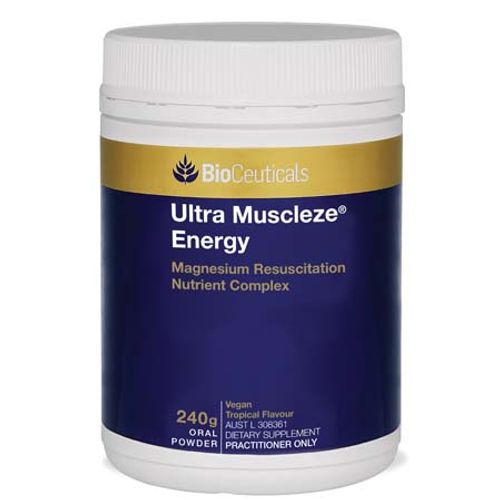
ULTRA MUSCLEZE ENERGY 240g
RRP $56.95 Inc GST
ULTRA MUSCLEZE ENERGY 240g
Ultra Muscleze Energy provides a readily bioavailable source of magnesium through Magnachel, a specialised form of an amino acid chelate. Magnesium supports physical endurance when dietary intake is inadequate, maintains energy levels and helps relieve fatigue. Magnesium helps reduce the occurrence of muscle cramps when dietary intake is inadequate and maintains muscle function. Vitamins B5 and B6 assist in the synthesis of neurotransmitters with magnesium supporting nervous system function. A vegan, tropical flavoured oral powder.
- Magnesium (as amino acid chelate - Magnachel) 320 mg
- Glutamine 500 mg
- Taurine 500 mg
- Levocarnitine tartrate 293.25 mg (equiv. to levocarnitine 200 mg)
- Ribose (d Ribose) 200 mg
- Calcium ascorbate dihydrate 121.7 mg (equiv. to ascorbic acid (vitamin C) 100 mg, equiv. to calcium 11.44 mg)
- Thiamine hydrochloride (vitamin B1) 30 mg
- Riboflavin sodium phosphate (active vitamin B2) 34.2 mg (equiv. to riboflavin (vitamin B2) 25 mg)
- Riboflavin (vitamin B2) 25 mg
- Nicotinamide (vitamin B3) 50 mg
- Calcium pantothenate 87.3 mg (equiv. to pantothenic acid (vitamin B5) 80 mg, equiv. to calcium 7.34 mg)
- Pyridoxal 5 phosphate monohydrate (P5P) (active vitamin B6) 36.5 mg (equiv. to pyridoxine (vitamin B6) 25 mg)
- Pyridoxine hydrochloride 30.4 mg (equiv. to pyridoxine (vitamin B6) 25 mg)
- Calcium folinate 163 micrograms (equiv. to folinic acid (activated vitamin B9) 150 micrograms)
- Hydroxocobalamin (vitamin B12) 100 micrograms
- Calcium (as calcium hydrogen phosphate dihydrate) 41.3 mg
- Chromium (as picolinate) 25 micrograms
- Potassium (as aspartate) 11 mg
- Selenium (as selenomethionine) 25 micrograms
- Zinc (as zinc amino acid chelate) 5 mg
- Coenzyme Q10 (as ubidecarenone) 75 mg
Adults: Take 8g (2 level scoops) once a day, or as professionally prescribed. Only use the scoop provided. Mix in 100mL to 200mL or water of juice and consume immediately.
If you are pregnant or breastfeeding, talk to your health professional before use.
WARNING - Stop taking this medication if you experience tingling, burning or numbness and see your healthcare practitioner as soon as possible [contains vitamin B6].
This product contains selenium which is toxic in high doses. A daily dose of 150micrograms for adults of selenium from dietary supplements should not be exceeded.
Do not take while on warfarin therapy without medical advice.
Contains sulfites, soya bean products and ribose which is a sugar.
Magnesium taken in high doses may cause loose stools.
Magnesium supplementation should be done cautiously in people with compromised renal function and is contraindicated in renal failure and heart block.
Concomitant use of aminoglycoside antibiotics and magnesium can increase the risk for neuromuscular weakness.
Magnesium salts may reduce absorption of digoxin.
Patients with chronic renal failure should only take glutamine under professional supervision.
Glutamine is contraindicated in severe liver disease. Monitor ammonia levels in people with impaired liver function.
Observe patients on warfarin taking CoQ10 dosing higher than 100 mg.
Theoretically, vitamin B3 may have additive effects when used with anticoagulant or antiplatelet drugs, especially in patients on haemodialysis.
Vitamin B6 should not be used in high doses (>100 mg) long-term, as this can induce toxicity.
Concurrent use of anti-seizure medications with vitamin B6 should be monitored.
Vitamin B12 may reduce tetracycline hydrochloride (antibiotic) bioavailability; separate doses by at least two hours.
Calcium supplements can have an antagonistic effect on the action of calcium channel blockers.
Concurrent administration of levothyroxine and calcium may reduce drug absorption; separate doses by at least 4 hours.
Concurrent administration of quinolone antibiotics and calcium may reduce drug efficacy; take quinolones either 2 hours before or 4-6 hours after calcium.
Concurrent administration of tetracycline antibiotics and calcium may reduce drug efficacy; separate doses by at least 2 hours.
Calcium can interact with numerous drugs and should be used with caution by people with renal disease or hyperparathyroid conditions.
Caution with potassium in patients with kidney disease, heart disease or adrenal insufficiency. Monitor potassium levels.
ACE inhibitors may produce hyperkalaemia when used in combination with potassium supplements.
Beta-adrenergic blockers may elevate potassium levels; caution use with potassium containing supplements.
Cyclosporine and heparin may produce hyperkalaemia due to decreased potassium excretion; caution use with potassium containing supplements.
Concomitant use of potassium-sparing diuretics with potassium containing supplements increases the risk of hyperkalaemia.
Selenium may have antiplatelet effects and may increase the risk of bleeding if used with anticoagulant or antiplatelet drugs.
Zinc may reduce tetracycline and quinolone antibiotic levels; take these drugs either 2 hours before or 4-6 hours after zinc.
Zinc may interfere with penicillamine; separate doses by 2 hours.
Avoid combination -
Calcium: Alendronate - Agents affecting calcium and bone metabolism
TGA Online Product Information: Alendronate
Calcium:Ceftriaxone - Cephalosporins
FDA Information for Healthcare Professionals: Ceftriaxone (21/4/2009)
Calcium: Ciprofloxacin - Quinolones
The influence of chronic administration of calcium carbonate on the bioavailability of oral ciprofloxacin.
Effects of aluminum hydroxide and calcium carbonate antacids on the bioavailability of ciprofloxacin.
Interference of dairy products with the absorption of ciprofloxacin.
Effect of multiple staggered doses of calcium on the bioavailability of ciprofloxacin.
Calcium: Clodronate - Agents affecting calcium and bone metabolism
TGA Online Product Information: Clodronate
Calcium: Demeclocycline - Tetracyclines
Interactions with the absorption of tetracyclines.
Calcium: Dolutegravir
Pharmacokinetics of dolutegravir when administered with mineral supplements in healthy adult subjects.
Calcium: Doxycycline - Tetracyclines
Interactions with the absorption of tetracyclines.
Calcium: Etidronate - Agents affecting calcium and bone metabolism
TGA Online Product Information: Etidronate
Calcium: Ibandronic acid - Agents affecting calcium and bone metabolism
TGA Online Product Information: Ibandronic acid
Calcium: Minocycline - Tetracyclines
Interactions with the absorption of tetracyclines.
Absorption of minocycline hydrochloride and tetracycline hydrochloride. Effect of food, milk, and iron.
Calcium: Norfloxacin - Quinolones
Inhibition of norfloxacin absorption by antacids.
Inhibition of norfloxacin absorption by dairy products.
Pharmacokinetic interactions of norfloxacin with some metallic medicinal agents.
Calcium: Risedronate - Agents affecting calcium and bone metabolism
TGA Online Product Information: Risedronate
Calcium: Tetracycline - Tetracyclines
Interactions with the absorption of tetracyclines.
Calcium: Tiludronate - Agents affecting calcium and bone metabolism
TGA Online Product Information: Tiludronate
Skelid (tiludronate disodium) Prescribing Information.
Magnesium: Alendronate - Agents affecting calcium and bone metabolism
TGA Online Product Information: Alendronate
Magnesium: Ciprofloxacin - Quinolones
Reduced enteral absorption of ciprofloxacin in the presence of antacids.
Magnesium: Clodronate - Agents affecting calcium and bone metabolism
TGA Online Product Information: Clodronate
Magnesium: Demeclocycline - Tetracyclines
Influence of ranitidine, pirenzepine, and aluminum magnesium hydroxide on the bioavailability of various antibiotics, including amoxicillin, cephalexin, doxycycline, and amoxicillin-clavulanic acid.
Magnesium: Doxycycline - Tetracyclines
Influence of ranitidine, pirenzepine, and aluminum magnesium hydroxide on the bioavailability of various antibiotics, including amoxicillin, cephalexin, doxycycline, and amoxicillin-clavulanic acid.
Magnesium: Etidronate - Agents affecting calcium and bone metabolism
TGA Online Product Information: Etidronate
Magnesium: Ibandronic acid - Agents affecting calcium and bone metabolism
TGA Online Product Information: Ibandronic acid
Magnesium: Minocycline - Tetracyclines
Influence of ranitidine, pirenzepine, and aluminum magnesium hydroxide on the bioavailability of various antibiotics, including amoxicillin, cephalexin, doxycycline, and amoxicillin-clavulanic acid.
Magnesium: Moxifloxacin - Quinolones
Evaluation of the influence of antacids and H2 antagonists on the absorption of moxifloxacin after oral administration of a 400mg dose to healthy volunteers.
Magnesium: Norfloxacin - Quinolones
Norfloxacin interaction with antacids and minerals.
Pharmacokinetic interactions of norfloxacin with some metallic medicinal agents.
Magnesium: Penicillamine - Antirheumatoid agents
Reduction in oral penicillamine absorption by food, antacid, and ferrous sulfate.
Magnesium: Proguanil - Antimalarials
The effect of magnesium trisilicate on proguanil absorption.
Magnesium: Risedronate - Agents affecting calcium and bone metabolism
TGA Online Product Information: Risedronate
Magnesium: Tetracycline - Tetracyclines
Influence of ranitidine, pirenzepine, and aluminum magnesium hydroxide on the bioavailability of various antibiotics, including amoxicillin, cephalexin, doxycycline, and amoxicillin-clavulanic acid.
Magnesium: Tiludronate - Agents affecting calcium and bone metabolism
TGA Online Product Information: Tiludronate
Skelid (tiludronate disodium) Prescribing Information.
Niacin: Warfarin - Anticoagulants, antithrombotics
Critically elevated INR in a patient on warfarin after increase in extended-release niacin dose
Zinc: Demeclocycline - Tetracyclines
Interactions with the absorption of tetracyclines.
Zinc: Minocycline - Tetracyclines
Interactions with the absorption of tetracyclines.
Zinc: Norfloxacin - Quinolones
Norfloxacin interaction with antacids and minerals.
Zinc: Tetracycline - Tetracyclines
Effect of zinc sulphate on the absorption of tetracycline and doxycycline in man.
Caution -
Calcium: Sotalol - Beta-adrenergic blocking agents
Effect of food, food constituents and fluid volume on the bioavailability of sotalol.
Calcium: Thyroxine - Thyroid hormones and antithyroid agents
Calcium carbonate and reduction of levothyroxine efficacy.
Effect of calcium carbonate on the absorption of levothyroxine.
Chromium: Thyroxine - Thyroid hormones and antithyroid agents
New medications which decrease levothyroxine absorption.
Coenzyme Q10: Warfarin - Anticoagulants, antithrombotics
Effect of coenzyme Q10 and Ginkgo biloba on warfarin dosage in stable, long-term warfarin treated outpatients. A randomised, double blind, placebo-crossover trial
Risk of warfarin-related bleeding events and supratherapeutic international normalized ratios associated with complementary and alternative medicine: a longitudinal analysis
Folate: Phenytoin - Anticonvulsants
Influence of folic acid on blood-phenytoin levels.
Phenytoin and folic acid interaction: a preliminary report.
Phenytoin and folic acid: individualized drug-drug interaction.
Folic acid improves phenytoin pharmacokinetics.
Phenytoin-folic acid interaction.
Folate: Warfarin - Anticoagulants, antithrombotics
Effects of folic acid supplementation on the pharmacokinetics and anticoagulant effect of warfarin: an open-label, prospective study of long-term administration in adults.
Magnesium: Amikacin - Aminoglycosides
Potentiation of magnesium sulfate-induced neuromuscular weakness by gentamicin, tobramycin, and amikacin.
Magnesium: Chlorpromazine - Antipsychotic agents
Chlorpromazine: effects of antacids on its gastrointestinal absorption.
Magnesium: Gentamicin - Aminoglycosides
Potentiation of magnesium sulfate-induced neuromuscular weakness by gentamicin, tobramycin, and amikacin.
Magnesium: Nitrofurantoin - Other antibiotics and anti-infectives
Effect of magnesium trisilicate on nitrofurantoin absorption.
Magnesium: Tobramycin - Aminoglycosides
Potentiation of magnesium sulfate-induced neuromuscular weakness by gentamicin, tobramycin, and amikacin.
Selenium: Warfarin - Anticoagulants, antithrombotics
Modification of the effects of aflatoxin B1 and warfarin in young pigs given selenium.
Vitamin B6: Levodopa - Movement disorders
Pyridoxine reversal of L-dopa effects in Parkinsonism.
Failure of vitamin B6 to reverse the L-dopa effect in patients on a dopa decarboxylase inhibitor.
Vitamin B6: Phenobarbitone - Anticonvulsants
Pyridoxine and serum concentration of phenytoin and phenobarbitone.
Vitamin B6: Phenytoin - Anticonvulsants
Pyridoxine and serum concentration of phenytoin and phenobarbitone.
Vitamin C: Indinavir - Antiviral agents
Effect of high-dose vitamin C on the steady-state pharmacokinetics of the protease inhibitor indinavir in healthy volunteers.
Vitamin C: Propranolol - Beta-adrenergic blocking agents
Influence of vitamin C on the absorption and first pass metabolism of propranolol.
Vitamin C: Warfarin - Anticoagulants, antithrombotics
Possible warfarin resistance due to interaction with ascorbic acid: Case report and literature review
Vitamin E: Warfarin - Anticoagulants, antithrombotics
Risk of mortality with vitamin E supplements: the Cache County study.
The effect of vitamin E on warfarin-induced vitamin K deficiency.
Effect of vitamin E on the anticoagulant response to warfarin.
Effects of vitamin E on stroke subtypes: meta-analysis of randomised controlled trials.
Zinc: Cephalexin - Cephalosporins
The Effect of Staggered Administration of Zinc Sulfate on the Pharmacokinetics of Oral Cephalexin
Zinc: Penicillamine - Antirheumatoid agents
Treatment of Wilson's disease with zinc: XI. Interaction with other anticopper agents.
Controlled trial of D-penicillamine in rheumatoid arthritis. Dose effect and the role of zinc.