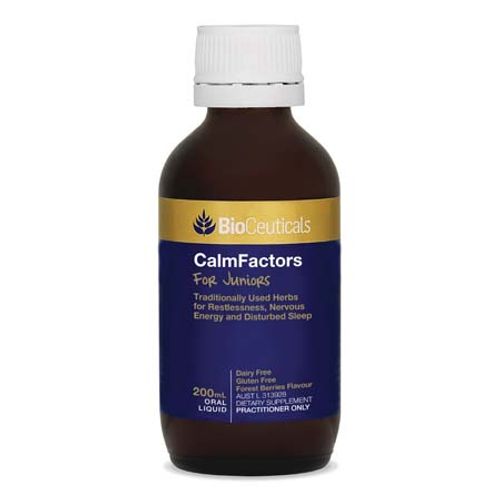
CALMFACTORS FOR JUNIORS 200ml
RRP $27.50 Inc GST
CALMFACTORS FOR JUNIORS 200ml
Valerian and passionflower are traditionally used in western herbal medicine to relieve disturbed sleep, restlessness and nervous energy. Choline supports cognitive function when dietary intake is inadequate and helps the synthesis of neurotransmitters.
Pleasant forest berries flavour easily added to smoothies, juice or water.
- Valeriana officinalis (valerian) root 160 mg (min. equiv. to dry 640 mg, std. to valerenic acids 480 micrograms)
- Melissa officinalis (lemon balm) leaf 82 mg (equiv. to dry 320 mg)
- Passiflora incarnata (passionflower) herb 50 mg (equiv. to dry 250 mg)
- Inositol (myo-inositol) 125 mg
- Choline bitartrate 125 mg
Children 3-5 years: Take 5mL two times a day, or as professionally prescribed.
Children 6-12 years: Take 10mL on to two times a day, or as professionally prescribed.
13 years and over: Take 10mL one to four times a day, or as professionally prescribed.
Take liquid straight or mixed with water or juice.
Contains potassium sorbate.
Contains sulfites.
For children under 12 years, use only as professionally prescribed.
Avoid combination -
Valerian: Alprazolam - Antianxiety agents
Multiple night-time doses of valerian (valeriana officinalis) had minimal effects on CYP3A4 activity and no effect on CYP2D6 activity in healthy volunteers
Valerian: Lorazepam - Antianxiety agents
Interactions of Valeriana officinalis L. and Passiflora incarnata L. in a patient treated with lorazepam
Valerian: Midazolam - Sedatives, hypnotics
In vivo effects of goldenseal, kava kava, black cohosh, and valerian on human cytochrome P450 1A2, 2D6, 2E1, and 3A4/5 phenotypes
Caution -
Passionflower: Lorazepam - Antianxiety agents
Interactions of Valeriana officinalis L. and Passiflora incarnata L. in a patient treated with lorazepam
Inconclusive -
Lemon balm: Thyroid hormones and antithyroid agents
In vitro assay of thyroid disruptors affecting TSH-stimulated adenylate cyclase activity
Valerian: P-glycoprotein substrates
In vitro activity of commercial valerian root extracts against human cytochrome P450 3A4